

Znu CRM Intelligence
The CRM modules every growing business needs, native to the CRM you already use.
When the question is “Why isn’t our pipeline working?” — the honest answer is usually decayed data, mis-routed leads, and invisible attribution. These have been the same three problems for thirty years. Every CRM should ship with the modules that solve them. None of them do.
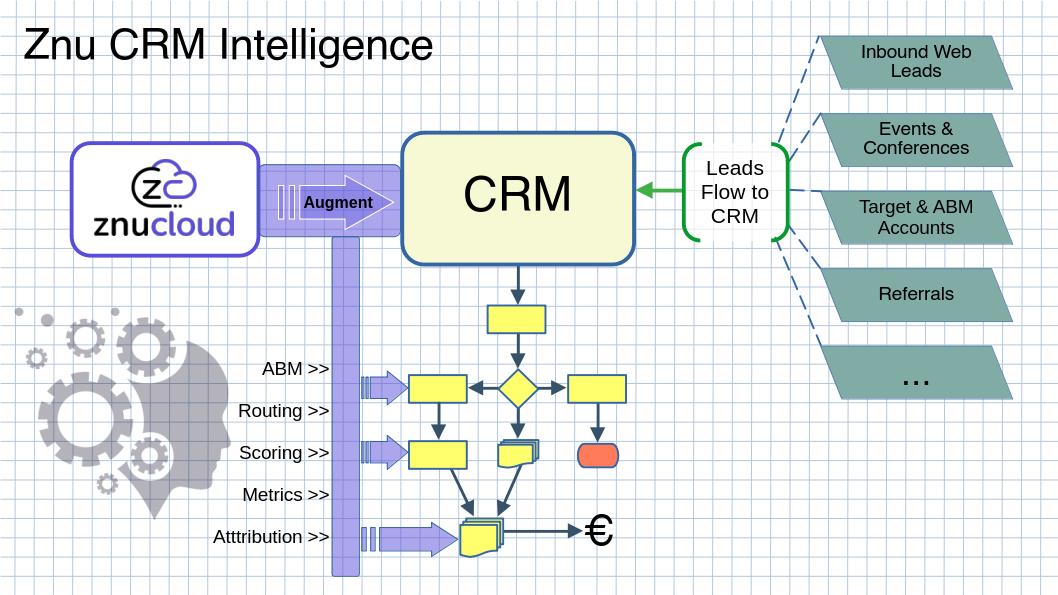
Znu CRM Intelligence delivers those missing modules — enrichment, routing, attribution, metrics, scoring, ABM — natively inside the CRM you already use. Not a separate dashboard. Not a parallel system. Real CRM behavior, working the way the CRM should have worked all along. And every engagement starts the same way: with a diagnostic that measures, in concrete numbers, what your data problem is actually costing you.
Start With a Diagnostic
Before any module is deployed, we run our matching and enrichment engine against an export of your CRM and report what we find:
- How many company records are stale — merged, renamed, relocated, or closed under the name you have on file
- How many records are duplicates, and which ones
- How many written-off leads are recoverable, matched against our reference set of 16 million European companies
- What the recovered pipeline is plausibly worth to your business
The deliverable is a live dashboard and an exportable report your team keeps. Fixed scope, defined timeline, read-only access to an export — we never touch your production system during a diagnostic, and your data never leaves EU infrastructure. The diagnostic is designed to be worth the fee even if you never speak to us again. It is also, candidly, how we earn the next conversation.
The Market This Replaces
The complete go-to-market data stack — enrichment, routing, scoring, attribution, ABM — exists. It has existed for years. It is sold by a hot-house ecosystem of well-funded US vendors who charge $3000-$5000 per month per discrete service, behind annual contracts, sold by Account Executives whose compensation depends on closing six-figure deals.1
A complete stack from this ecosystem typically exceeds €100 000 per year at list price, often €150 000 or more with full ABM tooling. But the pricing is not the real barrier. The real barrier is that these vendors do not sell to growing European SMEs at all. Their sales motion is built for VC-funded buyers at Series B and later — companies with budget approval thresholds that make €100K stack purchases routine. The vendors follow the money. They are not pursuing the market of 23 million European SMEs that actually need these capabilities.
Growing European businesses are left with three options: build the modules themselves (a multi-year engineering investment), buy fragmented free or low-cost tools that don’t integrate (which is what most do, badly), or operate without — which means decayed data, broken routing, and no attribution. The capabilities that would fix all this have been industry-standard for a decade. The market simply does not serve the businesses that need them.
The regulatory dimension compounds the problem. Most US-headquartered RevOps tools default to US infrastructure under transfer arrangements that many SME customers have never assessed against current EDPB recommendations.2 An Estonian company using a Boston-based enrichment vendor frequently carries transfer-compliance exposure it does not know it has.
Znu CRM Intelligence is built to deliver the same capabilities — enrichment, routing, scoring, attribution, ABM — at a price European SMEs can sustain, on infrastructure that does not create that exposure, delivered the way EU SMEs actually buy: a bounded diagnostic first, then an ongoing service.
What the Modules Do
Modules deploy in sequence, not as a big-bang install. The enrichment and matching core is in production today — it has run continuously for five years — and every engagement begins there. The remaining modules are activated per engagement as the data foundation under them comes clean.
Enrichment
Inbound leads arrive incomplete. A web form captures an email and a company name; the rest is missing. Znu CRM Intelligence enriches every new record within minutes — verified company data, industry classification, employee count, technology stack — drawn from our 16-million-company European reference set and contractually assessed commercial sources. By the time a sales rep opens the record, the work is done.
Routing
Leads that aren’t routed to the right rep within hours convert at a fraction of the rate of leads routed within minutes.3 The Routing module applies your territory rules, account ownership, round-robin logic, or capacity-based assignment automatically as records enter the CRM. No more weekly cleanup meetings reassigning misrouted leads.
Attribution
The single most expensive gap in most SME pipelines: marketing doesn’t know which programs generate revenue, and sales doesn’t know which sources convert. Attribution closes the loop. Every closed-won deal traces back to its originating touchpoints — first-touch, last-touch, multi-touch — across the full lifecycle. Quarterly reviews stop being arguments about whose budget worked and become conversations about reality.
Metrics
CRMs report what their dashboards were designed to report — usually pipeline coverage, win rate, and forecast accuracy. The metrics that actually predict revenue (velocity, stage conversion rates, time-in-stage, leakage by source) require custom reports most SMEs never build. The Metrics module ships these out of the box, updated in real time, with the operational view RevOps actually needs.
ABM (Account-Based Marketing)
Account-based motion requires tooling most SMEs can’t afford: target account lists, account-level scoring, multi-contact orchestration, account-level reporting. The ABM module brings these into your existing CRM. You define your target accounts; the system tracks engagement across every contact and channel; the reporting shows progression at the account level, not just the contact level.
Scoring
Lead scoring done by hand is wrong; lead scoring done by static rules ages badly; lead scoring done by black-box AI is unauditable. The Scoring module uses transparent, rule-based logic with weighted factors you can inspect and adjust. Every score comes with a breakdown of why — which factors fired, which thresholds were met. Sales managers can defend the scores to skeptical reps; marketing can adjust the model when the ICP shifts.
Built Inside Your CRM, Not Beside It
Znu CRM Intelligence integrates natively with Salesforce, HubSpot, and Pipedrive today; further platforms are added as partner demand directs. The modules run inside the CRM’s data model — your reps see enriched data on the lead record they already use, your managers see scoring breakdowns in the views they already check, your reports pull from the fields your dashboards already query.
This matters because the alternative is a separate dashboard your team has to open, learn, and remember to check. Most parallel-system tools fail not because they’re bad products, but because the operational behavior they require doesn’t survive contact with how sales teams actually work. Native integration eliminates the adoption problem.
Operational metrics also stream to PostgreSQL or your customer data platform (Segment, RudderStack, Tinybird) for analytics work that exceeds what CRM dashboards can do. The CRM stays the system of record; the data platform becomes the analytical layer; the two are connected without you maintaining the pipeline.
Privacy and Data Sovereignty
Znu CRM Intelligence is built EU-first by architecture:
- EU data residency. All processing of customer CRM data happens on EU infrastructure (Hetzner, Germany). Customer data does not leave EU jurisdiction.
- Assessed data sources. Every commercial data source in the enrichment chain is contractually assessed for GDPR transfer compliance before it touches a customer record, and the full sub-processor chain is documented and available to customers.
- No data resale. Your CRM data is processed to deliver the service you’ve contracted for. It is never sold to third parties, never used to enrich other customers’ records, never aggregated into commercial datasets.
- Auditable processing. Every enrichment and matching action is logged with provenance. Your data team can answer “where did this field value come from?” — increasingly required by EU regulators and enterprise customers.
Who This Is For
Znu CRM Intelligence is built for RevOps, sales operations, and marketing operations leaders at growing European businesses — companies running a real CRM, managing inbound lead volume, and tired of the choice between expensive US-built tooling and going without.
If you’ve spent any time evaluating Cognism, Clay, ZoomInfo, LeanData, Bombora, or any of the discrete-tool ecosystem, you’ll recognize the modules. The difference is the assembly: one vendor, one contract, one integration surface, one bill, priced for businesses operating in euros, regulated under European law.
In Development: The Intelligence Layer
Clean, current CRM data is the foundation for everything a business wants from AI — strategy tools built on a decayed CRM are guessing. The Znu AI Strategy Portal, a structured reasoning environment calibrated for European SME realities, is in active development on top of the remediation layer described on this page. Remediation customers will see it first.
Read about the Portal preview →
The US RevOps vendor ecosystem is structurally calibrated for VC-backed buyers. Account Executive compensation models, annual commit requirements, and six-figure deal floors are not incidental — they are how the vendors achieve the unit economics their growth-stage investors require. Product-led growth and low-touch sales motions do not fit these models, which is why the EU SME market has been systemically underserved despite high latent demand. List pricing for a complete stack (Cognism + LeanData + Bizible/Dreamdata + Demandbase/6sense) routinely exceeds €100 000 annually before negotiation, with €120-150K typical for full ABM coverage. ↩︎
GDPR enforcement under Schrems II has tightened requirements for US data transfers, particularly for commercial data enrichment vendors. See European Data Protection Board, Recommendations 01/2020 on measures that supplement transfer tools to ensure compliance with the EU level of protection of personal data, for the framework against which transfer arrangements should be assessed. ↩︎
Lead response time decay is one of the most-replicated findings in sales operations research. Harvard Business Review’s 2011 study of 2241 US companies found that firms responding within an hour were seven times more likely to qualify the lead than those responding in the second hour, and sixty times more likely than those responding after twenty-four hours. The effect has if anything accelerated as inbound channels have matured. ↩︎